

About us
Diocesan Caritas Ostrava-Opava is a part of Caritas of the Czech Republic. It is separated religious legal entity established by the bishopric of Ostrava. Our work is focused mainly on providing of social services to wide range of target groups (youth, Roma people, families, unemployed, elderly people, homeless people, children from socially disadvantaged background, migrants, etc.). Diocesan Caritas covers several centres dealing with different problems and target groups – Coexistence Village, with the social activation centre Horizont and the Humanitarian Aid Centre.
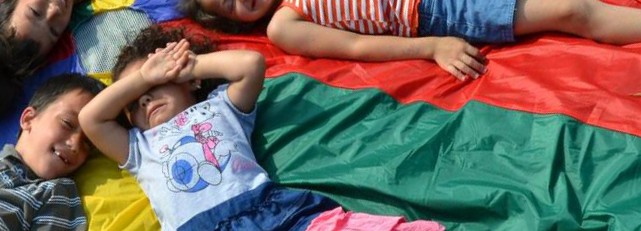
The Coexistence Village http://vs.charita.cz/en/coexistence-village/ provides continuous social programs aimed at social inclusion and prevention of socially negative phenomena related to excluded areas. The Village consists of 30 family houses and community centre building. Thirty families live here together. Ten of thirty families are Roma origin, ten are non-Roma, and ten are mixed, with total number of about 130 people. As a part of the Coexistence Village there is a community centre where social services as well as leisure time activities are offered to the target group. From social services we can mention social counselling (debt counselling, labour and family affairs, housing issues) or giving extra lessons to children. In the afternoon children (age 6-19) from local communities can attend hobby clubs such as creative workshops, painting, English workshops, music club or religious education.
Horizont centre http://vs.charita.cz/en/horizont-center/ is located in another socially excluded area called Ostrava – Kunčičky. The centre provides social activation services for families with children that found themselves in situations they are not able to solve. Its main mission is to support social integration and positive change in a lifestyle of children and youth in unfavourable social situation. For children and youth who reject or who are not able to take part in standard social programmes, there is a low-threshold Horizont club offering leisure time activities and other activities aimed at inclusion of children and youth into the community.
Diocesan Caritas Ostrava-Opava also deals with humanitarian issues which are in the hands of Humanitarian Aid Centre situated in the building of Caritas headquarters in the centre of Ostrava city. Apart from local issues, the centre is also responsible for the humanitarian aid activities and projects in western part of Ukraine. Most activities connected with Ukraine are related to project called "Child Sponsorship Program", which is aimed at increasing of educational level and quality of life of children from socially disadvantaged families in western Ukraine. The Humanitarian Aid Centre is also involved in activities concerning drug prevention. Another activity of Humanitarian Aid Centre realised in the Moravian-Silesian region is a support of integration of immigrants living here. We provide them with social and legal counselling in the areas of health, labour, family and other issues connected with living in the Czech Republic. The Humanitarian Aid Centre is run only by three employees but in case of need it cooperates with many local volunteers.
Experience with EVS
We host volunteers through EVS from 2013 and our first volunteer was from France and her name is Marie. This experience was unforgettable, very interesting and beneficial for both parts. Thanks to EVS we learned better cooperation between our centres and our workers and we broke the stereotype at our work. Not only did the volunteer bring a new culture, language and behaviour between us, but she also revived atmosphere in our workplace. As we were really satisfied, we decided to write other project. The second volunteer, Selene, was from Italy. Firstly, we had to learn to manage different situation as the beginning was quite hard since few misunderstandings occurred. Nevertheless, we and the volunteer solved these problems jointly and then both sides were very satisfied. Italian enthusiasm spread through our centres and Selene became inseparable part at work with children. They loved her and they enjoyed activities prepared by her. We hope she was as content as we were.